



You already pulled off the impossible once. As a child — with no grammar book, no flashcards, no exams — you absorbed an entire language: thousands of words, every sound, every rhythm, just by living inside it. iconRead is built to let that same quiet magic happen again, in English.
The science: Krashen's quiet revolution
Linguist Stephen Krashen spent decades proving what most classrooms still ignore: we don't learn a language by memorizing rules — we acquire it by understanding messages we actually care about. He called the engine comprehensible input: when you understand language just a step beyond your current level (he wrote it i + 1), your brain builds the language for you, silently, with no drilling required.
Two of his ideas sit at the heart of iconRead:
Comprehensible input. Acquisition happens when input is understood. The goal isn't to water English down — it's to make real English understandable, one word at a time.
The affective filter. Anxiety, boredom, and the fear of being wrong raise a wall that blocks acquisition. Curiosity and enjoyment tear it down — so the input has to be compelling, something you genuinely want to watch.
Why pictures? Your brain keeps two copies
There's a second engine under the hood, and it's the reason for the icon in iconRead. Psychologists call it dual coding: a word stored only as a translation is one fragile trace, but a word fused to an image is stored twice — once as language, once as a picture — and each copy can revive the other. That's why you can forget a definition you copied ten times, yet never forget what umbrella looks like in the rain.
So iconRead never asks you to route English through your first language. Long-press a word and you see it (a gallery of images), hear it (native pronunciation), and read it (the dictionary sense) — in the same breath, without leaving the story. Meaning attaches directly to English, the way it attached to your mother tongue.
The unfair advantage of frequency
Here's the best-kept secret in vocabulary research: English words are wildly unequal. The most common ~3,000 word families do the heavy lifting in roughly 95% of everyday speech. Master those, and comprehension snowballs — every new sentence teaches you the rare words for free, from context.
iconRead is built around that curve. Its vocabulary dial knows how common every word is: set it to your level and the app quietly ignores what you already know, aims its picture-boxes at the words just beyond you — your personal i + 1 — and re-tunes the whole experience every time you grow. Tell it a word is yours (flag it orange) and it never wastes your attention on it again.
Turn anything you love into a lesson
Input only works if you actually want it. So iconRead turns your content into living, tappable reading:
Any YouTube video — paste a link, get word-synced subtitles you can read like a book.
Any text — paste an article, a chapter, song lyrics — and read it with pictures, or let the built-in narrator read it to you while every spoken word lights up.
Any photo of a page — snap a menu, a sign, a paperback. iconRead reads the picture and rebuilds it as a lesson.
Your own voice — talk, and your speech becomes a text you can study. Reading your own words in English is strangely addictive.
And because one word can mean five things, iconRead's sense-detection (the little WSD badge) reads the story the way you do — so by the river you get the river bank, not the one with ATMs.
Vocabulary that sticks — because you lived it
You won't memorize these words. You'll meet them — in context, fused to an image, a voice, and a moment in a story you cared about — and meet them again a video later, which is exactly the spaced re-encounter memory feeds on. The My Learned Words tab keeps the receipts: every word you've ever looked up, how many times you've met it, and which ones you've already claimed as yours. Watching that list grow is watching yourself acquire a language.
Open a video. Hold your finger on a strange word. Let your brain do what it was built to do.
语言学家 Stephen Krashen(克拉申) 用几十年的研究证明了一件事:语言不是"学"会的,是"习得"的。当你接触到能听懂、又恰好略高于现有水平的内容(他写作 i + 1)时,大脑会在你毫无察觉之间,自己把这门语言搭建起来——根本不必去背语法。它只有两个前提:内容要看得懂,而且你是真的想看——焦虑和无聊会竖起一道"情感过滤"的墙,把输入挡在门外;好奇与享受才能把墙拆掉。
iconRead turns videos, texts, photos — even your own voice — into picture-supported reading. This page is the complete manual: every tab, button, dial and gesture, in the order you'll meet them.
1. Try it in 60 seconds
No account needed: open the Demo Video Post tab and play with the reader — every tap and toggle works, it just isn't saved. When you're ready to keep your progress, hit Register (top-right) and sign up with your email (you'll get a confirmation link) or continue with Google or Apple. One habit to know: iconRead runs in one browser tab at a time — if you see the "already open in another tab" screen, just close the extra tab.
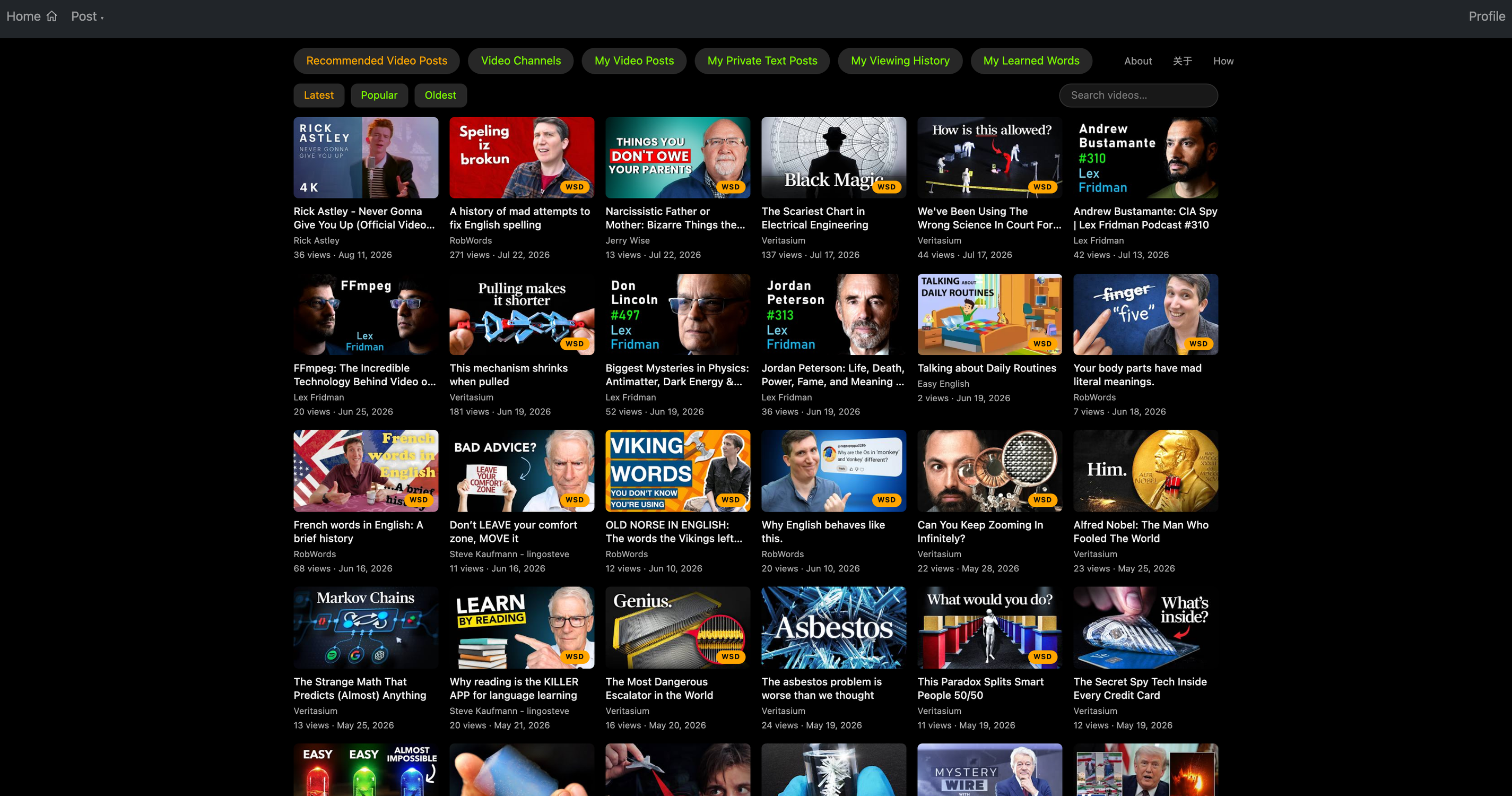
2. The home page
The home page — section tabs across the top, cards below, endless scroll.
The tab bar is your map:
Recommended Video Posts — the public library. Sort with the Latest / Popular / Oldest chips, or type in the search box to filter by title. Scroll and more cards load by themselves.
My Video Posts — videos you've posted. The extra Hidden chip lists cards you've hidden, each with a Restore menu to bring them back.
My Private Text Posts — your text, photo-text and voice posts. Private means exactly that: only you can open them.
My Viewing History — where you left off, newest first. Each card's ⋮ menu can remove the entry or hide the post itself.
My Learned Words — your personal dictionary-in-progress (see §8).
3. The reader
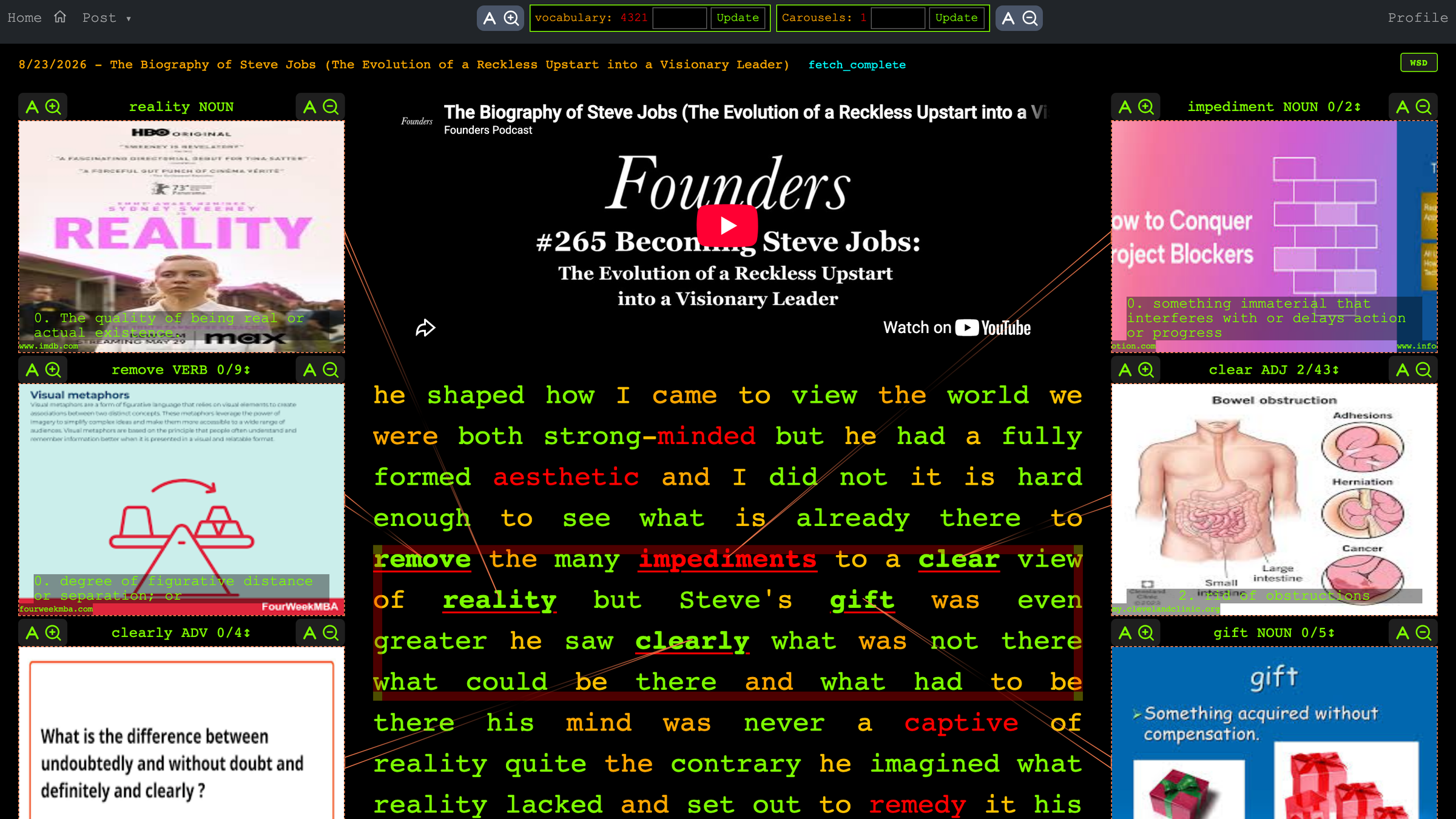
The reader: video up top, subtitles in the middle, picture "word boxes" linked by coral arrows.
Three layers share the screen:
The video — a normal player: play, pause, scrub.
The subtitles — they scroll in sync. Words are colour-coded by rarity at your vocabulary level, so your eye lands on the ones worth learning. Words you've flagged as known show orange.
The word boxes — every word inside the "trap" (§5) gets a box of meaning-pictures, tied to its word by an arrow.
Two gestures do almost everything:
Tap a word → the player jumps there and replays that line. Missed a sentence? Tap its first word and hear it again — instant, unlimited listening practice.
Hold a word (long-press, about half a second) → the meaning panel opens (§4). This is the "what does that mean?!" gesture.
Fullscreen turns the reader into a focused, TV-style view — the subtitle panel floats over the video and stays draggable, and every gesture keeps working.
4. The meaning panel — see it, hear it, own it
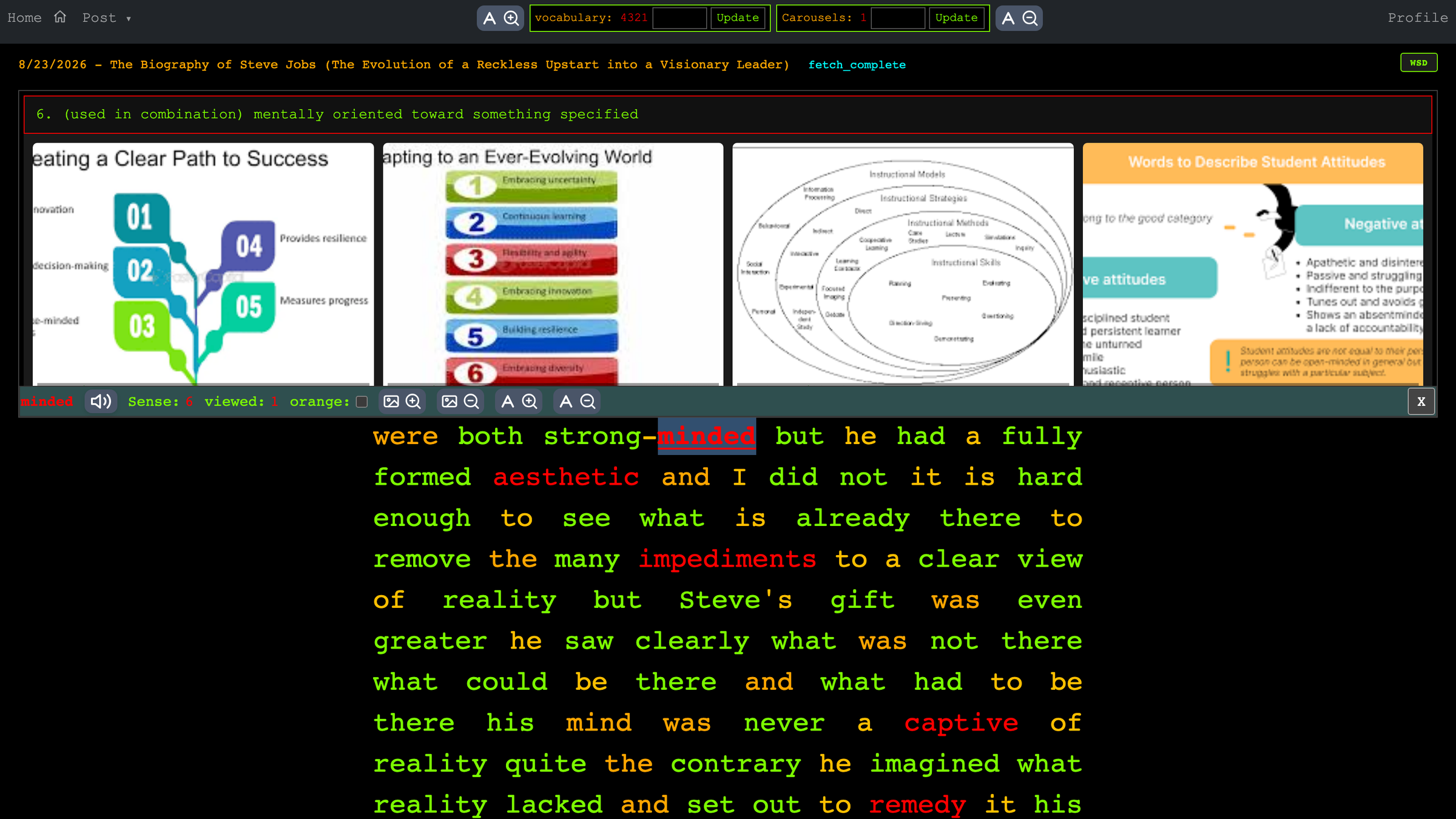
Hold any subtitle word: pictures, pronunciation, definitions, and your learning controls.
Pictures — a gallery of what the word means. Swipe left/right for more images of a sense; swipe up/down to move between senses.
🔊 Pronunciation — the speaker reads the word aloud so sound and meaning fuse.
viewed: — how many times you've held this word. It's your encounter counter, and it feeds the My Learned Words table.
orange — the "I've got this one" switch. Tick it and the word turns orange in the subtitles, stops being trapped into picture boxes, and stops spending your attention. Untick any time if it slips away.
Definition — the dictionary senses, numbered; the sense the story is actually using is what the pictures aim for.
5. The trap — aim the pictures
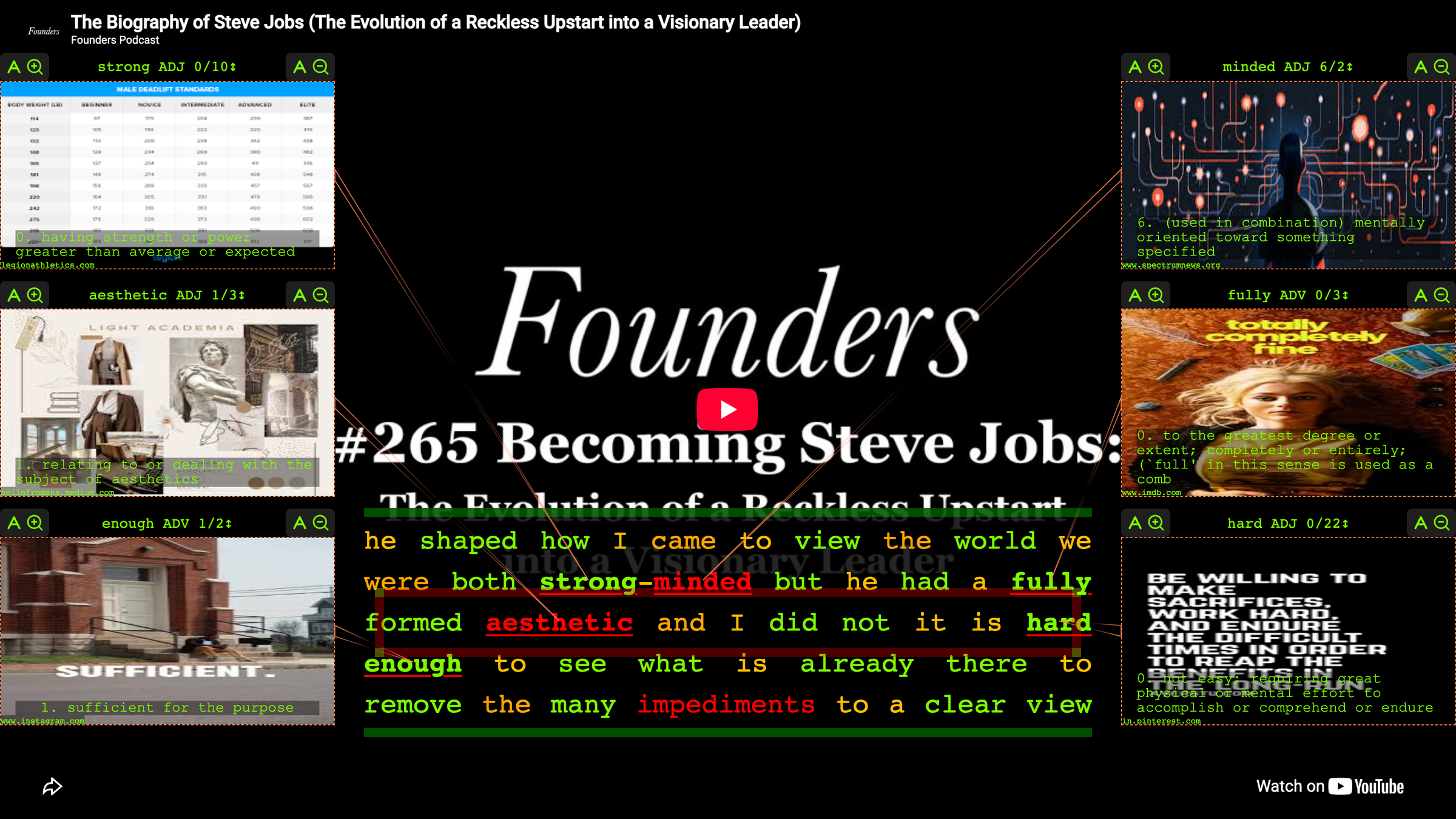
The framed window floating over the subtitles is the trap. Whatever falls inside it gets picture boxes and arrows. Drag it to a different line; drag its edges or corners to trap more or fewer words at once. As subtitles scroll, the boxes chase the words automatically. Think of it as a searchlight: park it where the unknown words are.
6. Word boxes — senses & images
Each box is a tiny two-way carousel: swipe up/down to flip through a word's senses (the title reads e.g. move VERB 2/3), swipe left/right to flip through images of that sense.
The small A glasses on a box's title bar resize just that box's caption text.
7. Dials and glasses — tune the machine
Anything resizable uses a magnifier "glass" — + enlarges, − shrinks — and the icon in front says what it resizes: A = text, photo icon = pictures.
Top bar on a post: A glasses resize the subtitle text; vocabulary and Carousels are the two learning dials.
vocabulary — the most important number in the app. It's your frequency rank: "treat the N most common English words as known". Start around 3000 (the everyday-English core). Too many boxes on words you know → raise it. Lost without help → lower it. The colour-coding and the trap both re-aim instantly. This is how you keep the input at i + 1.
Carousels — how many picture boxes may animate at once. Fewer = calmer screen; more = richer scaffolding.
In the meaning panel: photo glasses resize the pictures, A glasses resize the definition text.
8. My Learned Words — watch yourself grow
Every word you've ever held lands in the My Learned Words tab: Word, Viewed (how many times you've met it), and Orange (a dot on the ones you've claimed as known). Click any column head to sort — most-viewed first is a beautiful portrait of what you've been wrestling with. It fills up by itself; all you did was read.
9. Post your own content — the Post menu
Post ▾ → Video: paste a YouTube link and iconRead builds a reader out of it.
The Post ▾ menu (top-left, when logged in) is how anything becomes a lesson:
Video (uTube link) — paste any YouTube link. iconRead embeds the video and fetches word-timed subtitles. Public: it appears in Recommended for everyone.
Text (private) — paste any text: an article, a chapter, lyrics. It becomes a picture-supported reading page only you can see.
OCR Text (private) — upload a photo of text: a book page, a menu, a screenshot, a street sign. iconRead reads the picture and turns it into a text post, with the photo kept as its thumbnail.
Voice to Text (private) — record yourself (or a conversation, up to 30 minutes) and iconRead transcribes it into a readable, tappable post — with the recording attached, so the words light up as your own voice plays back.
OCR and Voice are metered (see §11) — the menu item turns orange when today's free run is used up, and clicking it then shows the Premium page.
10. Reading a text post — narration and sense-detection
Text, OCR and Voice posts open in the same reader, minus the video. Two buttons live in the post's info bar:
TTS — generate a natural-voice narration of the post. An audio bar appears where the video would be; as it plays, each spoken word lights up in the text, and tapping a word replays from there — your text becomes an audiobook with karaoke subtitles. Generating costs one daily run; replaying a finished narration is always free.
WSD — run word-sense disambiguation over the post. English words are shape-shifters ("bank", "bat", "spring"); WSD reads the context and locks each ambiguous word to the sense the story actually uses, so the pictures and definitions match the plot. Posts that have it show a small WSD badge on their card.
11. Free vs Premium
The AI services — OCR, Voice, TTS, WSD — cost real compute, so the free plan includes one run of each per day: a full daily study loop, forever free. Premium (Profile → Premium) raises every one of them to 10 a day (with a weekly allowance of 30 per service) — enough to digitize a chapter, narrate it, and disambiguate it all in one sitting. Cancel any time; watching videos and posting them is not metered at all.
12. Share iconRead — the partner programs
Profile → Partner program gives you a personal link and three ways to be rewarded when people you invite become active readers: Referrer (a one-time deal — 3 active sign-ups earns you a free month of Premium), Promoter (ongoing credit toward Premium for every active reader), or Marketer (real cash, paid via PayPal, admin-approved). One program at a time — you can end one and switch whenever you like.
13. Your account
Top-right: your Profile card — settings, Premium, partner program, logout.
The Profile card (top-right) holds everything administrative: update your name and email, change your password, open Premium and the Partner program, log out — and, should you ever want it, delete your account permanently.
14. A 15-minute daily recipe
Pick a video you'd watch anyway — compelling beats educational.
Park the trap on the subtitle line, and tap-replay any sentence that got away.
Hold only the words that block understanding — you don't need every word, you need the message.
Flag words you know orange so the app aims at your true frontier.
End on My Learned Words, sorted by Viewed — your day's harvest, on one screen.
Fifteen focused minutes a day beats three heroic hours on Sunday — memory is built by returning, not by cramming.
That's every switch in the cockpit. Open the demo, hold a strange word, and you'll have the hang of it in a minute.
不用注册:打开 Demo Video Post(演示)标签,直接把玩阅读器——所有点按都有效,只是不会保存。想保留进度时,点右上角 Register 注册:用邮箱(会收到确认邮件),或直接用 Google / Apple 登录。一个小习惯:iconRead 同一时刻只在一个浏览器标签页里运行——看到"已在其他标签页打开"的提示,把多余的标签页关掉即可。
2. 主页
主页——顶部是分区标签,下方是卡片,一直滚就一直加载。
顶部标签栏是你的地图:
Recommended Video Posts(推荐视频)——公共视频库。用 Latest / Popular / Oldest 排序,或在搜索框里按标题筛选;往下滚会自动加载更多。
My Video Posts(我的视频)——你发布的视频。多出的 Hidden 排序键列出你隐藏过的卡片,每张都有 Restore 菜单可以恢复。
My Private Text Posts(我的私人文本)——你的文本、拍照识别和语音帖。私人就是字面意思:只有你能打开。
My Viewing History(观看历史)——上次读到哪里,最新在前。每张卡片的 ⋮ 菜单可以删除这条记录,或隐藏那篇帖子。